Viking Burner Clicks But Will Not Light: Read It Before You Buy Igniters
What stops a Viking sealed burner lighting when the spark is plainly working: cap, ports, moisture, module. Viking Repair Sammamish, (425) 610-8986.
A Viking sealed burner that clicks and clicks and never catches is one of the most common calls we take on the Sammamish plateau, and it is also one of the most commonly misdiagnosed. The default assumption — from homeowners and from a surprising number of technicians — is a failed igniter. On these ranges that is near the bottom of the list, not the top. The spark electrode is a ceramic post with a wire in it. There is very little to fail, and when one genuinely does, it usually fails by cracking, which you can see.
What actually stops a burner lighting is almost always something in the path between the gas valve and the point where spark meets mixture. Work that path in order and you will identify it in ten minutes without a meter.
Start with what the clicking is telling you
First, note whether the clicking follows the one knob you turned or carries across the whole cooktop. That difference is what separates a single-burner fault from a switch or module fault, and it costs nothing to listen for before anything is opened.
Second, stop the burner rather than keep sparking it. A burner that sparks and never catches is putting unburnt gas into the burner box, so turn the knob off and leave it off. Any smell of gas ends the checks there: light nothing, touch no switch, take everyone outside and ring the gas company or 911 from there. Viking Repair Sammamish reads gas delivery with a manometer, (425) 610-8986 — it is not a reading anyone should take by nose.
Third, note whether it is one burner or several. One burner misbehaving is nearly always mechanical — the cap, the head or the ports. Several burners misbehaving at once, or clicking that will not stop when everything is off, moves the suspicion upstream to the spark module or a switch.
The cap and head account for most of these
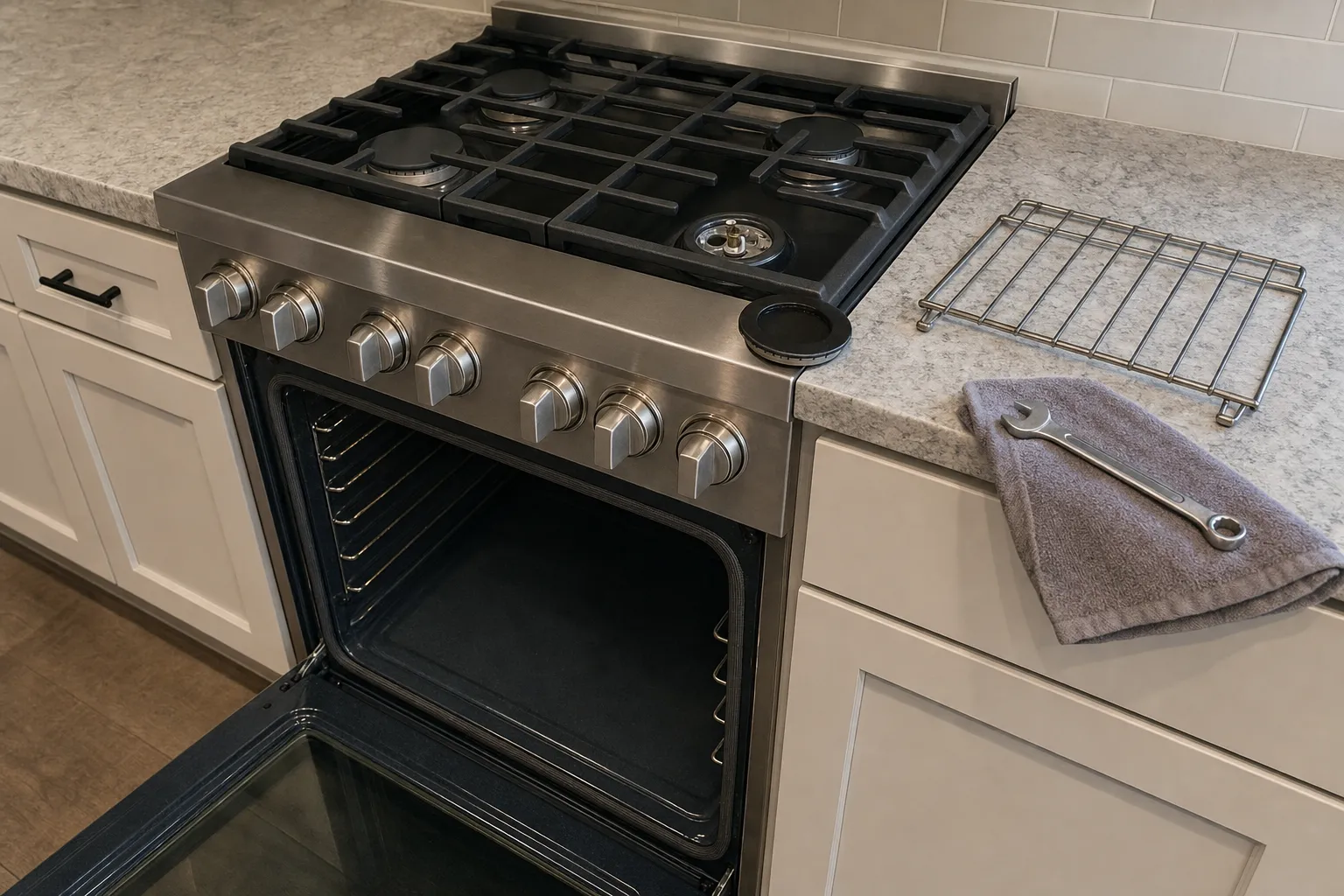
Lift the burner cap off, cold. On a single-burner fault these four are what we look for first:
- The cap is sitting off-seat. These caps locate on small pins or a machined ledge. If a cap has been dropped, or refitted after a clean without seating fully, the flame path is skewed away from the electrode and the burner will spark forever without catching. Reseat it and feel it drop into position.
- The cap and head are damp. After a boil-over, or the morning after a hearty cleaning, water sitting in the burner bowl bridges the electrode gap. Spark energy takes the wet path instead of jumping the air gap. This one is responsible for a startling proportion of “the range died overnight” calls. Dry everything, including the underside of the cap, and leave it apart for an hour.
- The ports are blocked. Sugar from a boil-over is the worst offender because it carbonises into a hard glaze. Push a straight pin through each plugged port. Viking rules out a toothpick and says never to enlarge or distort a port: an oversized port produces a lifting, noisy, yellow flame that then gets diagnosed as a gas-pressure fault.
- The head is misaligned on the base. The head must sit square so its igniter notch faces the electrode. A quarter turn out is enough to stop ignition.
Fit it all back dry and square, and try again before doing anything else. If it lights, run it for a minute and confirm the flame carries all the way around the crown rather than lighting in one spot and creeping.
When the spark module is genuinely the fault
If several burners spark weakly, if the click rate sounds slow or irregular, or if the range clicks continuously with every knob in the off position, the spark module is a real candidate. It is a small potted box, usually mounted at the back of the burner box, and it fails in two recognisable ways.
The first is output degradation: it still clicks, but the spark is thin and yellow-white rather than a fat blue snap, and burners that used to catch on the second click now need five or six. The second is the stuck-on failure, where the module fires continuously because a switch has welded closed or moisture has bridged a contact. Continuous sparking with the gas off is not dangerous, but it is also not something to live with, because the same moisture is now sitting in the harness.
Before condemning a module, pull the harness connector and look at the terminals. Green corrosion on the spade connectors is common on plateau installs where a range sits near an exterior wall and sees real humidity swings, and cleaning them has fixed more than one “failed module” for the cost of nothing.
The gas-side faults you should not chase yourself
There is a category of fault where the burner hardware is fine and the spark is fine, and the mixture arriving at the port is simply wrong. Yellow, lazy, sooty flames on burners that do eventually light, flames that lift off the port, or a range that lights fine on high but drops out the moment you turn it to simmer all point here.
The usual causes are manifold pressure out of specification, an orifice set for the wrong fuel after a propane conversion that was never completed properly, or a partially failed valve that cannot hold a low-flow setting. These need a manometer on the manifold tap and a comparison against the rating plate. They are also the faults where guessing has a real cost, because the wrong conclusion means running a gas appliance outside its designed combustion range.
If you smell gas with everything off, stop reading and leave the house, then call your gas utility from outside. That is not a repair question.
What it comes down to
Order matters more here than odds. The cap, the head and the ports come first because they cost nothing to check and a homeowner can put them right. Moisture, in the burner bowl or in the module harness, comes next. A tired spark module after that. Valve and pressure faults come last, because they are the only ones on the list that need instruments.
That is worth knowing before you order parts. Igniter electrodes get sold to people constantly for a fault they were never causing, one burner at a time, and the range keeps clicking. Take the cap off first. It costs nothing and it is the answer more often than anything you can buy.
Asked after this one
One knob turned, every electrode clicking: is that a fault?
Listen for whether the clicking follows the one knob you turned or carries across the cooktop: that difference separates a single-burner fault from a switch or module fault. What is never normal is clicking that continues with every knob off — that points at a stuck switch or a moisture-bridged electrode.
Can I clean the burner ports myself?
Yes, and it is worth doing first. Lift the cap and burner head off when everything is cold and push a straight pin through each plugged port. Viking rules out a toothpick and says never to enlarge or distort a port. Dry the parts fully before refitting.
How long should a burner take to light?
Two to four sparks. Anything past about five seconds of continuous clicking means gas is not reaching the electrode gap in a usable mixture, and continuing to spark just fills the burner box with unburnt gas.